| IC Advice & VariousA Bright Spark - Your Ignition Choices The basics of Spark Ignition are easy to grasp. The compressed fuel/air mixture, drawn into your engine is detonated by an electrical spark, triggered when the piston reaches Top Dead Centre (or within a few degrees). Now repeat - 100 times each second (@ 6,000rpm)! In the early auto-industry (<1918), the HT Magneto ruled supreme. The elegance here is that no battery is required. With this system the HT Magneto is a separate component geared to, and driven by the engine itself. A high current at low voltage is generated by the magneto, then transformed to a high voltage by an integral transformer. Once triggered - Kapow!! A majority of our IC Engines were developed to run with Contact Breaker Points and a High Tension Coil, powered by a Battery Pack. CB point systems rely upon the profile of a rotating cam to open and close the gap between 2 tungsten "pads". Opening the points triggers the HT Coil to send a single jolt down the HT lead and across the spark plug gap - Kapow!! Mechanical points survived in the automotive markets until around 1979, when Lucas, Bosch, Magnetti Marelli, AC Delco and Nippon Denso all changed over to transistorised, Hall Effect devices. Interestingly, this effect was discovered by Dr. Edwin Hall in 1879, 100 years before this application! The new devices signaled the demise of both points and fiendishly clever auto-advance mechanisms. Overnight there was no gap to set, no mis-matched faces to arc and burn and no high speed points-bounce. With the outline theory first patented by Nikola Tesla in 1897, Capacitor Discharge Ignition (CDI) systems only became viable in the late 60's. The main hindrance to progress, points-bounce, being ultimately overcome with the Hall Effect. Whilst CDI has still not taken-off in the mainstream engine world (and there's precious little time left!) it is the staple system for motorcycles, mowers, chainsaws, outboards and small racing engines. In this system a high voltage capacitor is charged then, when triggered, discharged into an integral (typically) HT Coil - Kapow!! Hemingway Recommends: MiniMag Co. For overseas customers, MiniMag are more than happy to deliver your order to Hemingway so that it can be included with your engine kit. Simply give our address as your delivery address. Commercial Spark Plugs - Your Choices
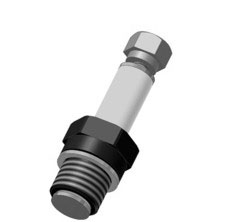
Rimfire VR2 Spark Plug (1/4" x 32tpi) Rimfire spark plugs were designed to outperform and replace the older generations of miniature spark plugs from the 1930s through the 1950s. Their physical sizes, designations, threads, and reach are nearly identical to the plugs that were most commonly used, but with added technological features to increase an engines performance. They are manufactured from the highest grades of material available and surpass that of most full-size automobile spark plugs. This plug size is specified for the Aero V-Twin, Whippet, Seagull, Seal, Seal Major and Sealion engines. The VR2 will also run perfectly in the Atom Minor Mk3, Kiwi and Wallaby even though these engines were originally designed to accept larger 3/8" x 24tpi plugs. Many constructors feel that the Rimfire VR2 is aesthetically more to scale. NGK CM-6 (M10 x 1mm Pitch) These are among the smallest mass manufactured plugs available and benefit from having a mass manufactured price. They are a suitable alternative for engines originally designed to accept 3/8" x 24tpi plugs that were commonly available in yester-year. In our engine range, they will suit the Kiwi, Atom Minor Mk3, Wallaby and Wyvern. The NGK CM-6 has a reach of 0.339" and the hex measures 13.8mm AF. Hemingway Recommends: MiniMag Co.
| ||||||||||||||||||||||||
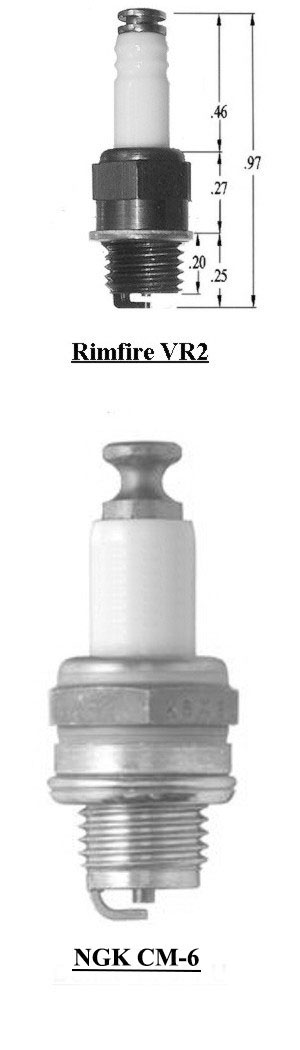 Two plug sizes cover our engine range: